
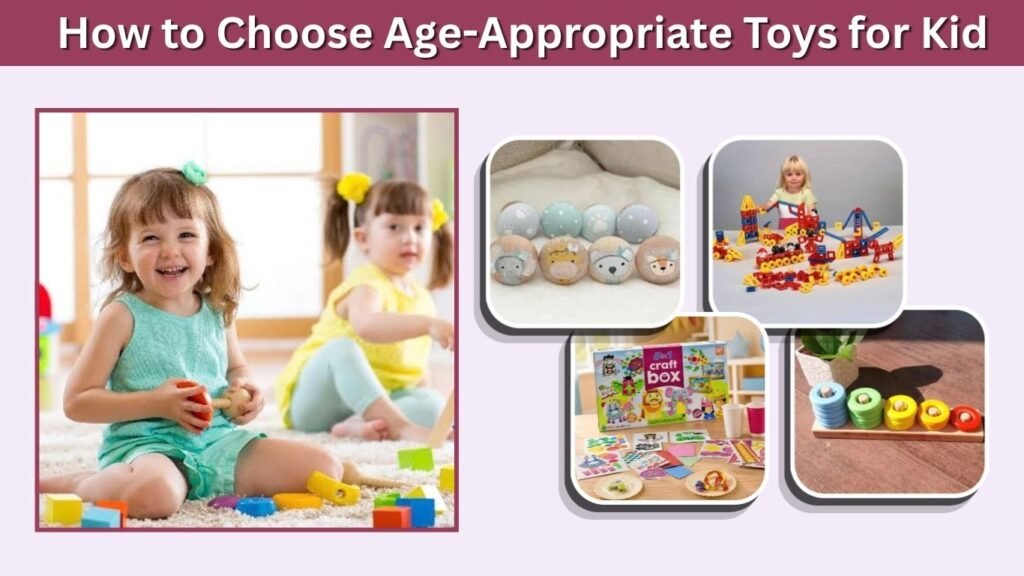
Choosing the right toy for a child means finding something that matches their age, abilities, interests, and stage of development. A toy that is too simple may become boring, while one that is too advanced can cause frustration or create safety concerns. Understanding how to choose age-appropriate toys helps parents and caregivers select products that are enjoyable, useful, and suitable for a child’s current skills. This guide explains what to look for at every stage, from infancy through the school years.
Why Age-Appropriate Toys Matter
Age-appropriate toys are designed around the developmental abilities children commonly have at different stages. They can support learning, movement, creativity, communication, and problem-solving while reducing unnecessary safety risks. Age recommendations are helpful, but they should be combined with an understanding of the individual child because children do not all develop at exactly the same pace.
They Match a Child’s Current Abilities
A suitable toy should challenge a child without making play unnecessarily difficult.
For example, a simple stacking toy may be ideal for a toddler learning hand-eye coordination, while an older child may need a construction set with more pieces and complicated building options.
When the difficulty level matches the child’s abilities, play tends to feel more rewarding.
They Can Reduce Safety Risks
Age recommendations often reflect safety factors as well as developmental expectations.
Toys intended for older children may contain small pieces, magnets, complicated mechanisms, or other features that are inappropriate for younger users.
Following age guidelines can help parents recognize potential hazards before introducing a new toy.
They Support Development Through Play
Children naturally develop new skills while playing. Appropriate toys can encourage them to practice abilities they are currently building.
These may include fine motor control, balance, language, social interaction, creativity, memory, and logical thinking.
The goal is not to turn every play session into a lesson, but to provide toys that create useful opportunities for exploration.
How to Read Toy Age Recommendations
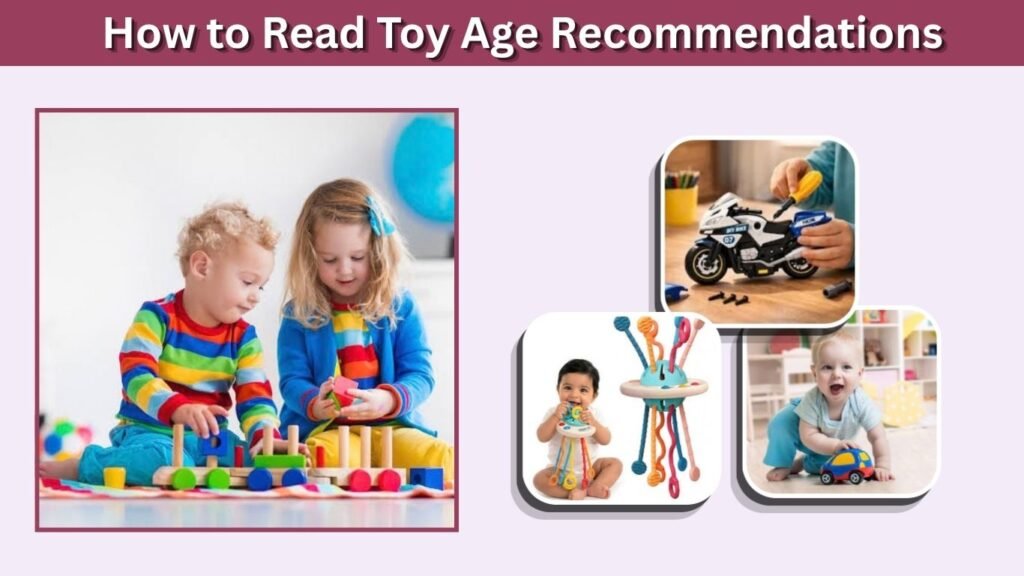
Most toy packaging includes a recommended age range, such as 6 months and up, ages 3 to 5, or ages 8 and older. These labels provide a useful starting point, but parents should understand what they actually represent. Age ratings may consider safety, complexity, required coordination, reading ability, and the expected attention span of children in that range.
Check the Minimum Age Carefully
The minimum age is particularly important when choosing toys for babies and toddlers.
Look for:
- Small detachable parts
- Long cords or strings
- Accessible batteries
- Loose magnets
- Sharp edges
- Hard projectiles
- Fragile components
A toy designed for an older child may still look appealing to a toddler, but appearance does not make it safe.
Consider the Child’s Developmental Level
Two children of the same age may have different skills and interests. One may enjoy complex puzzles, while another prefers active outdoor toys.
Age labels should therefore be treated as guidance rather than the only factor.
Consider whether the child can comfortably understand, hold, operate, or complete the activity without excessive help.
Check Whether Adult Supervision Is Needed
Some toys are appropriate only when an adult is present.
Craft kits, science activities, construction sets, cooking toys, and outdoor equipment may include tools, materials, or tasks that require supervision.
Always read the instructions before giving a child a new toy.
Best Age-Appropriate Toys for Babies
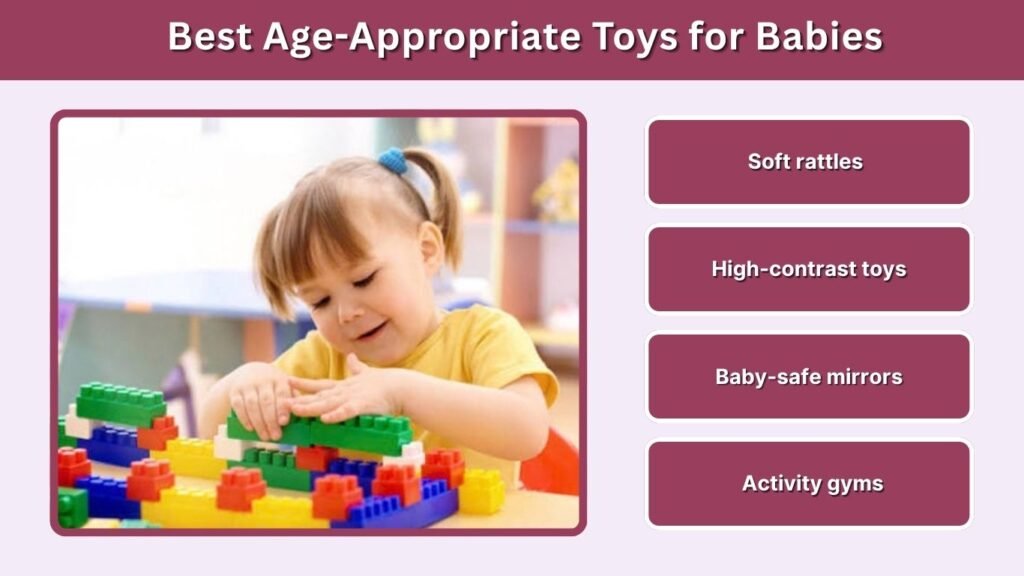
Babies learn primarily through sensory exploration. They look, touch, shake, grasp, mouth, and listen to objects around them. Toys for infants should therefore be simple, lightweight, easy to hold, and free from small detachable components. Bright colors, soft sounds, movement, and different textures can help keep babies engaged while supporting early sensory and motor development.
Birth to 6 Months
Young babies benefit from toys that stimulate sight, sound, and touch.
Good options include:
- Soft rattles
- Activity gyms
- High-contrast toys
- Baby-safe mirrors
- Soft sensory books
- Textured toys
- Lightweight grasping toys
At this stage, babies usually need toys that can be explored safely without requiring complicated movements.
6 to 12 Months
Older babies often become more active and may begin sitting, crawling, transferring objects between hands, and experimenting with cause and effect.
Suitable toys may include stacking cups, soft blocks, rolling balls, simple musical toys, and large shape-based activities.
Toys that respond when pushed, shaken, or moved can help babies understand that their actions produce results.
What to Avoid for Babies
Avoid anything containing pieces small enough to become a choking hazard.
Toys with loose buttons, exposed batteries, detachable decorative parts, sharp surfaces, or long cords should also be avoided.
Durability matters because babies may drop, throw, chew, or repeatedly bang toys during normal play.
Best Age-Appropriate Toys for Toddlers
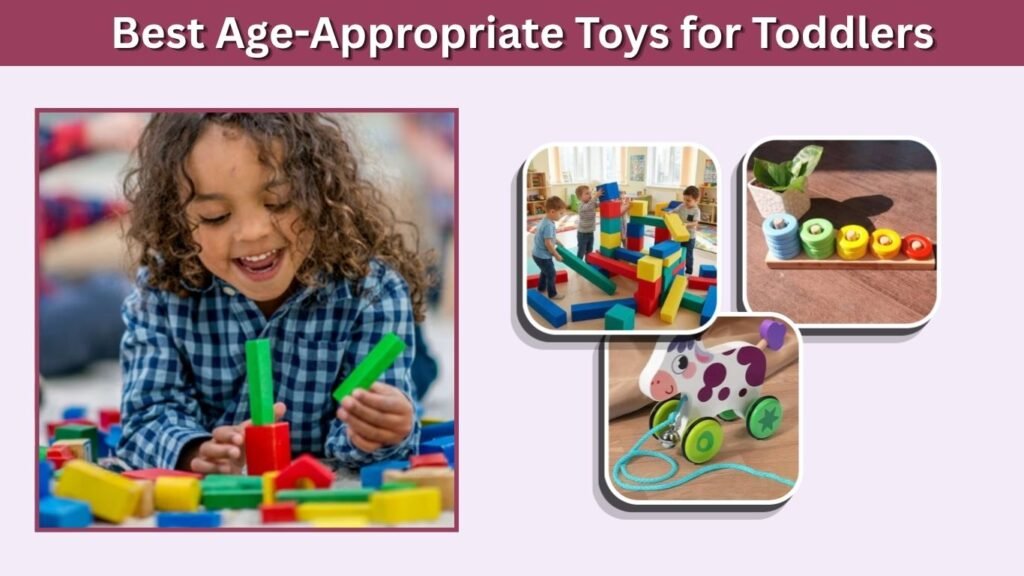
Toddlers are developing rapidly in movement, language, coordination, and independence. They often enjoy doing the same activity repeatedly while learning how objects fit together or respond to their actions. Good toddler toys are usually sturdy, simple to understand, and large enough to handle safely while encouraging movement, imagination, and early problem-solving.
Ages 1 to 2
Children in this age range often enjoy toys they can stack, push, pull, carry, and fit together.
Useful options include:
- Large building blocks
- Stacking rings
- Push-and-pull toys
- Simple shape sorters
- Chunky puzzles
- Large toy vehicles
- Soft dolls
- Musical toys
Simple toys with obvious cause-and-effect actions can be especially engaging.
Ages 2 to 3
As language and imagination develop, toddlers may begin enjoying more pretend play.
Play kitchens, toy food, dolls, animal figures, simple dress-up accessories, and larger construction toys can provide more opportunities for creative play.
Art supplies designed for young children can also support hand control and early creativity.
Look for Simple, Durable Designs
Toddler toys should tolerate frequent handling.
Look for rounded edges, strong connections, thick materials, and surfaces that are easy to clean.
Complicated toys with many delicate parts may not be practical for this age group.
Best Age-Appropriate Toys for Preschoolers
Preschool children usually have stronger fine motor skills, better language abilities, and more developed imaginations. They may enjoy creating stories, building detailed structures, drawing, solving puzzles, and playing cooperatively with other children. Toys for this age group should provide enough challenge to encourage learning while still allowing children to explore independently.
Ages 3 to 4
Children at this stage may enjoy:
- Pretend-play sets
- Building toys
- Large puzzles
- Art supplies
- Dress-up clothing
- Dolls and figures
- Toy vehicles
- Beginner board games
Pretend play often becomes more detailed as children begin creating characters and stories around their toys.
Ages 4 to 5
Older preschoolers may be ready for activities requiring greater concentration.
Construction sets, matching games, simple science activities, craft kits, and more detailed puzzles can help develop problem-solving and planning skills.
Games with basic rules can also teach children how to take turns and follow instructions.
Encourage Open-Ended Play
Open-ended toys can be particularly useful during the preschool years.
Blocks, art materials, figures, play dough, and pretend-play accessories allow children to decide what they want to create.
Because these toys do not have one correct outcome, they can support repeated imaginative play.
Best Age-Appropriate Toys for School-Age Kids
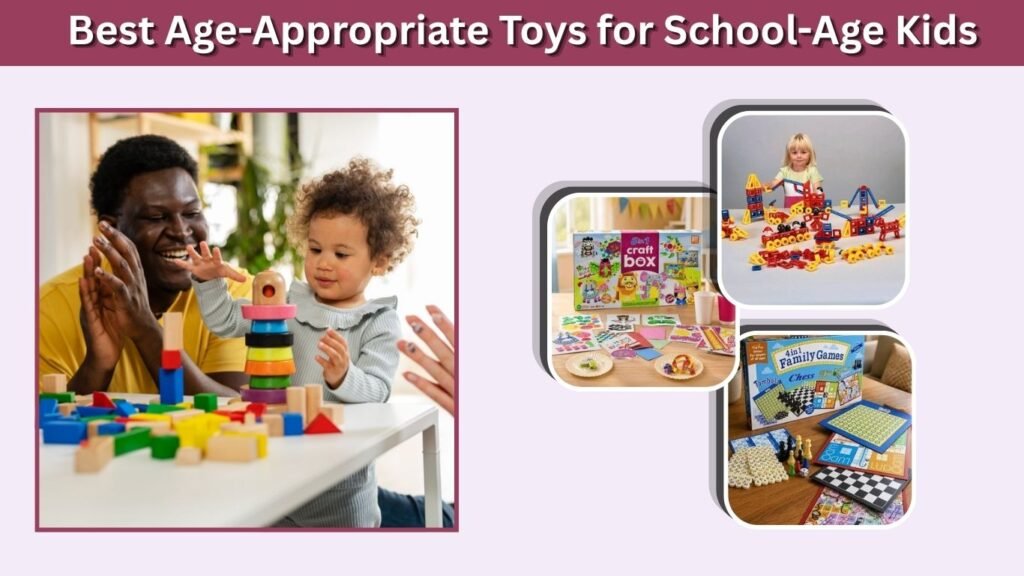
School-age children often have more defined interests and stronger problem-solving abilities. They may prefer hobbies, projects, games, sports, or construction activities that offer increasing levels of challenge. The best toys for this stage combine enjoyment with opportunities to practice concentration, creativity, physical coordination, and independent thinking.
Ages 5 to 7
Children in early elementary school may enjoy:
- Beginner STEM kits
- Building sets
- Board games
- Craft kits
- Sports equipment
- More complex puzzles
- Remote-control toys
- Beginner musical instruments
Toys that provide clear goals but still allow some creativity can work well.
Ages 8 to 10
Older children may be interested in more advanced projects.
Detailed construction kits, science sets, model building, strategy games, robotics kits, art projects, and outdoor sports can provide greater challenge.
At this stage, children’s personal interests often become one of the strongest factors when choosing toys.
Ages 11 and Older
Preteens may prefer activities connected to specific hobbies rather than traditional toys.
They might enjoy advanced STEM kits, creative tools, sports gear, musical equipment, collectible building sets, model kits, or strategy games.
Choosing based on genuine interests can help avoid products that feel too childish.
How to Match Toys With Developmental Skills
Chronological age provides useful guidance, but developmental skills can offer an even clearer picture of whether a toy is suitable. Parents should consider how the child moves, communicates, solves problems, and interacts with others. A toy that matches these abilities can provide a satisfying challenge without becoming overwhelming.
Fine Motor Skills
Fine motor skills involve small movements of the hands and fingers.
Toys that support these skills include puzzles, stacking toys, bead activities, construction sets, art supplies, and craft kits.
The size and difficulty of the pieces should increase gradually as children develop better control.
Gross Motor Skills
Gross motor skills involve larger body movements.
Useful toys include:
- Balls
- Ride-on toys
- Balance bikes
- Scooters
- Jump ropes
- Outdoor climbing equipment
- Sports sets
Choose equipment that matches the child’s size, coordination, and experience level.
Cognitive Skills
Puzzles, matching games, strategy activities, science kits, and construction toys can support reasoning and problem-solving.
The best challenge is one the child can complete with effort rather than one that requires constant adult intervention.
Social and Language Skills
Board games, puppets, dolls, pretend-play sets, and group activities can encourage communication and cooperation.
These toys may help children practice sharing, storytelling, taking turns, and listening to others.
Safety Tips When Choosing Toys by Age
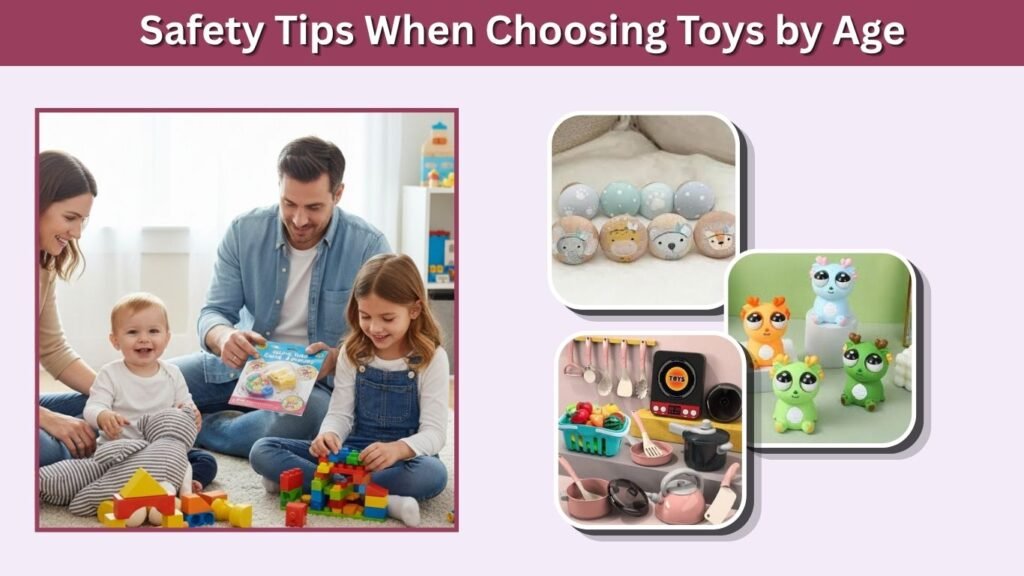
Safety considerations change as children grow. Babies face different risks than older children, while school-age toys may introduce tools, projectiles, electronics, or complex parts. Reading labels and inspecting products carefully can help parents choose toys that are appropriate for both the child’s age and the environment where they will be used.
Watch for Choking Hazards
Small objects are particularly dangerous for children under three.
Check:
- Loose wheels
- Small game pieces
- Decorative buttons
- Tiny accessories
- Detachable eyes
- Marbles
- Small balls
Also remember that toys belonging to older siblings can create hazards when younger children share the same play space.
Check Batteries and Magnets
Button batteries and powerful magnets require special care because swallowing them can cause severe injuries.
Battery compartments should be secured so children cannot easily open them.
Magnets should remain firmly enclosed within the toy and should not become accessible during normal use.
Inspect Toys Regularly
Even a safe toy can become unsafe after breaking.
Check toys occasionally for cracks, sharp edges, loose pieces, exposed wires, damaged batteries, or unstable connections.
Repair or remove damaged toys before children continue using them.
Common Mistakes When Choosing Toys by Age
Parents often have good intentions but may accidentally choose toys that are unsuitable because of advertising, trends, or assumptions about a child’s abilities. Looking beyond appearance and popularity can make toy selection more practical and help children enjoy products for longer.
Buying Toys That Are Too Advanced
Choosing a toy for an older age group does not always accelerate learning.
If a toy requires skills the child does not yet have, it may cause frustration or simply remain unused.
In some cases, it can also introduce safety risks.
Choosing Toys That Are Too Easy
A toy that requires almost no effort may quickly become boring.
As children develop, gradually introducing more complex puzzles, construction activities, games, and creative projects can keep play interesting.
Ignoring the Child’s Interests
Age suitability is important, but children still need to enjoy the toy.
A perfectly age-matched science kit may receive little attention if the child strongly prefers art, outdoor play, music, or building.
The best choice combines age appropriateness with genuine interest.
How to Choose Toys That Grow With Your Child
Toys that can be used in increasingly complex ways often provide better long-term value. Rather than replacing toys every few months, parents can look for products that allow children to develop new ways of playing as their skills improve. These toys can remain useful across several developmental stages.
Choose Adjustable Difficulty
Some puzzles, building systems, games, and educational sets offer different levels of challenge.
A child may begin with simple activities and later use the same toy for more complicated projects.
Look for Expandable Toy Systems
Construction sets, train systems, dollhouses, pretend-play collections, and some STEM toys can be expanded over time.
Adding new pieces may create fresh play opportunities without replacing the entire toy.
Prioritize Versatile Toys
Versatile toys can often be used differently as children grow.
A simple block set may first be used for stacking, later for building houses, and eventually for creating detailed designs.
This flexibility can make open-ended toys especially useful.
FAQs
1. Why is it important to choose age-appropriate toys?
Age-appropriate toys are more likely to match a child’s developmental abilities and safety needs. They can provide a suitable level of challenge while reducing risks associated with small parts, complex activities, or inappropriate features.
2. How can I tell if a toy is too advanced for my child?
A toy may be too advanced if the child cannot understand how to use it, becomes frustrated quickly, needs constant adult help, or lacks the physical skills required to operate it safely.
3. Should I always follow the age recommendation on toy packaging?
Age recommendations are an important starting point, especially for safety. You should also consider the child’s individual development, interests, abilities, and whether adult supervision is required.
4. What toys are best for toddlers?
Toddlers often benefit from large building blocks, shape sorters, push-and-pull toys, simple puzzles, pretend-play sets, toy vehicles, art supplies, and other durable toys with easy-to-understand activities.
5. Can younger children play with toys made for older kids?
It depends on the toy, but caution is necessary. Toys intended for older children may contain small parts, magnets, batteries, or complex features that are unsafe for younger children. Always check the manufacturer’s minimum age recommendation first.
