

Educational toys are play materials designed to help children learn while they explore, create, and have fun. These toys can support skills such as problem-solving, language, coordination, creativity, memory, and social interaction. From building blocks and puzzles to science kits and pretend-play sets, educational toys can suit many ages and developmental stages. Understanding what are educational toys, how they work, and which types provide meaningful learning opportunities can help parents and caregivers choose toys that encourage both enjoyable play and healthy childhood development.
What Are Educational Toys?
Educational toys are toys that encourage children to practice or develop useful skills through play. Some are designed specifically for learning numbers, letters, science, or problem-solving, while others support development more naturally through building, pretending, sorting, creating, or exploring. A toy does not need screens or complicated technology to have educational value.
Learning Through Play
Children often learn most naturally when they are actively involved in an activity.
A child stacking blocks may be learning about balance and size without realizing it. A puzzle can encourage problem-solving, while pretend play can develop language and imagination.
Educational play combines enjoyment with opportunities to experiment, make mistakes, and discover new solutions.
Educational Toys vs Regular Toys
The difference is not always clear-cut because many ordinary toys can provide educational benefits.
A simple ball can help develop coordination, while dolls may support social and imaginative play. The educational value often depends on how children interact with the toy rather than whether the packaging specifically describes it as educational.
Types of Educational Toys
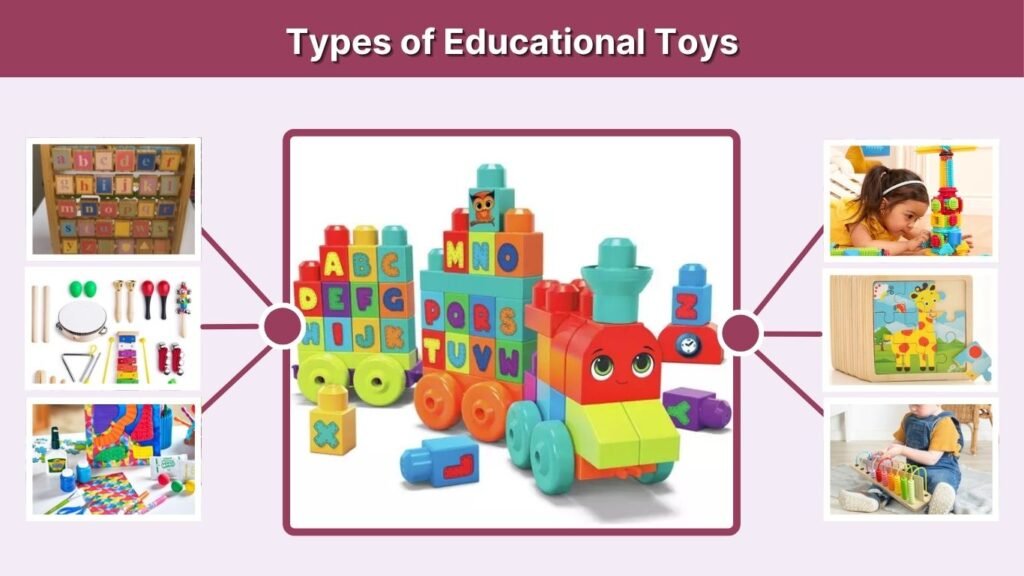
Educational and learning toys come in many forms because children develop several skills at the same time. Some toys focus on academic concepts, while others encourage motor development, creativity, communication, or logical thinking. Choosing several different types can provide children with a broader range of learning experiences.
Common Types of Educational Toys
Popular categories include:
- Building blocks
- Puzzles
- Shape sorters
- Counting toys
- Alphabet toys
- Science kits
- Art supplies
- Construction sets
- Pretend-play toys
- Memory games
- Musical toys
- STEM toys
Each category encourages different forms of exploration and learning.
Building and Construction Toys
Blocks and construction sets encourage children to create structures from individual pieces.
During this process, they practice spatial awareness, planning, hand-eye coordination, and problem-solving. Open-ended construction toys can also support creativity because there is usually no single correct way to play.
Puzzles and Matching Games
Puzzles require children to examine shapes, patterns, and relationships between pieces.
Matching and memory games can also encourage concentration and visual recognition. Difficulty should match the child’s developmental level so the activity remains challenging without becoming overly frustrating.
Benefits of Educational Toys for Kids
Educational toys for kids can support learning in ways that feel enjoyable rather than formal. Play gives children opportunities to repeat skills, explore new ideas, and develop confidence through practice. The benefits depend on the toy, the child’s age, and how actively the child participates in the activity.
Key Benefits of Learning Toys
Educational toys may help children:
- Strengthen problem-solving skills
- Improve hand-eye coordination
- Develop fine motor control
- Build vocabulary
- Practice counting and matching
- Encourage creativity
- Improve memory
- Support social interaction
- Develop concentration
- Build confidence
Many toys support several of these skills at the same time.
Cognitive Development
Educational toys can encourage children to think, plan, compare, remember, and solve problems.
Puzzles, construction toys, sorting activities, and strategy games challenge children to examine information and decide what to do next. Repeating these activities can gradually strengthen reasoning and persistence.
Physical Development
Manipulating small objects, stacking blocks, drawing, threading pieces, and assembling construction toys can improve fine motor skills.
Larger activity toys may help children develop balance, coordination, and gross motor control.
Educational Toys and Early Learning
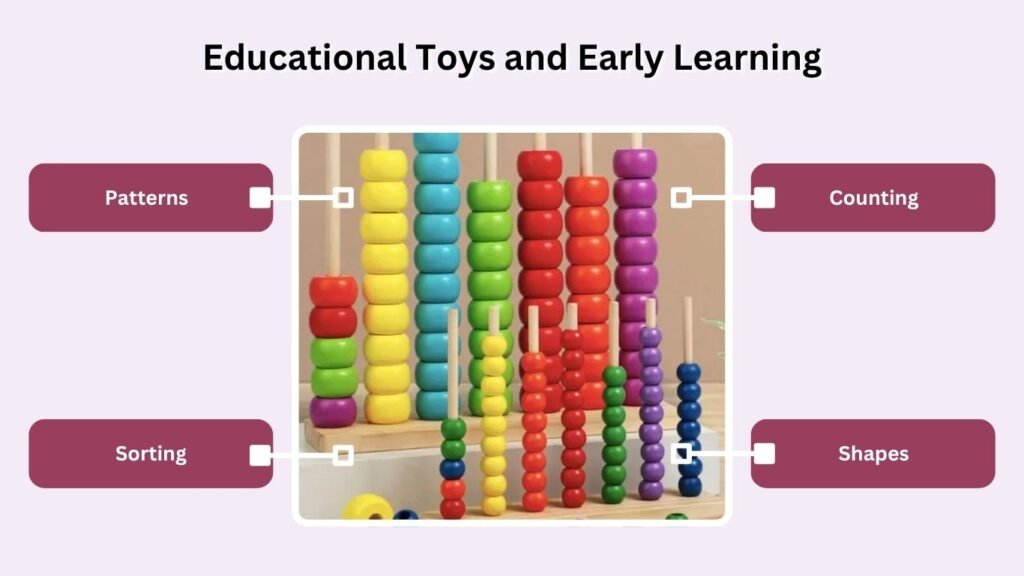
Early childhood is a period of rapid learning, and play provides a natural environment for children to experiment with new skills. Educational toys can introduce basic concepts gradually without turning every activity into a formal lesson. The best toys encourage active participation rather than simply presenting information.
Language and Communication
Books, puppets, pretend-play sets, alphabet toys, and storytelling games can encourage language development.
Adults can support learning by talking with children during play, naming objects, describing actions, and asking simple questions. These conversations introduce vocabulary naturally.
Numbers and Early Math Skills
Counting toys, number puzzles, blocks, and sorting activities can introduce early mathematical concepts.
Children may begin learning:
- Counting
- Size comparison
- Shapes
- Patterns
- Sorting
- Sequencing
- Basic measurement
Hands-on activities can make abstract ideas easier for young children to understand.
Creativity and Imagination
Art materials, building sets, dolls, figures, and pretend-play toys give children opportunities to create their own ideas.
Open-ended play encourages children to invent stories, build imaginary environments, and experiment without following a fixed solution.
Interactive Educational Toys
Interactive educational toys respond to a child’s actions through sounds, lights, movement, questions, or other feedback. These features can capture attention and introduce concepts such as letters, numbers, music, and language. However, interactive features are most useful when they encourage participation rather than passive watching.
Electronic Learning Toys
Some electronic learning toys include buttons, sounds, spoken words, songs, or simple quizzes.
They can reinforce concepts such as:
- Letters
- Numbers
- Colors
- Shapes
- Animal names
- Basic vocabulary
The strongest learning experience often occurs when adults participate and discuss what the child is doing.
Hands-On Interactive Toys
Interactive does not necessarily mean electronic.
Magnetic tiles, marble runs, construction kits, balancing toys, and science experiments are highly interactive because children control what happens. These toys often encourage experimentation and problem-solving.
How Educational Toys Support Social Skills
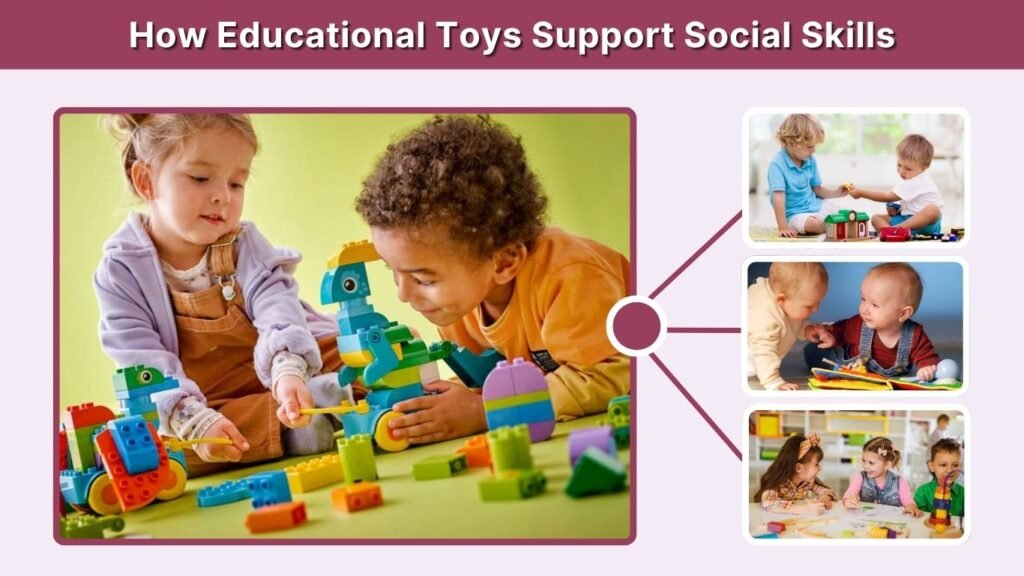
Learning is not limited to academic abilities. Many children’s educational toys encourage communication, sharing, cooperation, and emotional understanding. Playing with siblings, parents, classmates, or friends provides opportunities for children to practice interacting with others in everyday situations.
Cooperative Play
Board games, pretend-play sets, building projects, and group activities can encourage children to work together.
They may practice:
- Taking turns
- Sharing
- Listening
- Following rules
- Cooperation
- Negotiation
- Problem-solving together
These experiences gradually build social confidence.
Pretend Play
Pretend play allows children to act out familiar situations using toy kitchens, medical kits, dolls, vehicles, or costumes.
Through imaginary roles, children can practice communication while exploring how other people may think or feel.
Emotional Development
Toys can also help children express emotions they may not yet know how to explain directly.
For example, dolls and figures can be used to act out situations involving friendship, frustration, fear, or excitement.
How to Choose Educational Toys
Not every toy labeled educational will be suitable for every child. The most useful choice depends on age, interests, current abilities, and developmental needs. Toys should provide enough challenge to encourage learning while remaining enjoyable and safe to use.
Look for These Features
When choosing educational toys, consider:
- Age appropriateness
- Safety
- Durability
- Skill level
- Child’s interests
- Opportunities for creativity
- Hands-on interaction
- Open-ended play
- Appropriate challenge
- Replay value
A toy that can be used in several ways often remains interesting longer.
Choose Toys by Developmental Stage
Babies usually benefit from sensory and grasping toys, while toddlers may prefer stacking, sorting, simple puzzles, and pretend play.
Preschoolers often enjoy construction toys, art materials, board games, and more complex imaginative activities.
Avoid Overstimulation
More sounds, lights, and buttons do not automatically make a toy more educational.
Sometimes simple toys encourage deeper play because children have to use imagination and problem-solving rather than waiting for the toy to provide entertainment.
Educational Toys for Different Ages
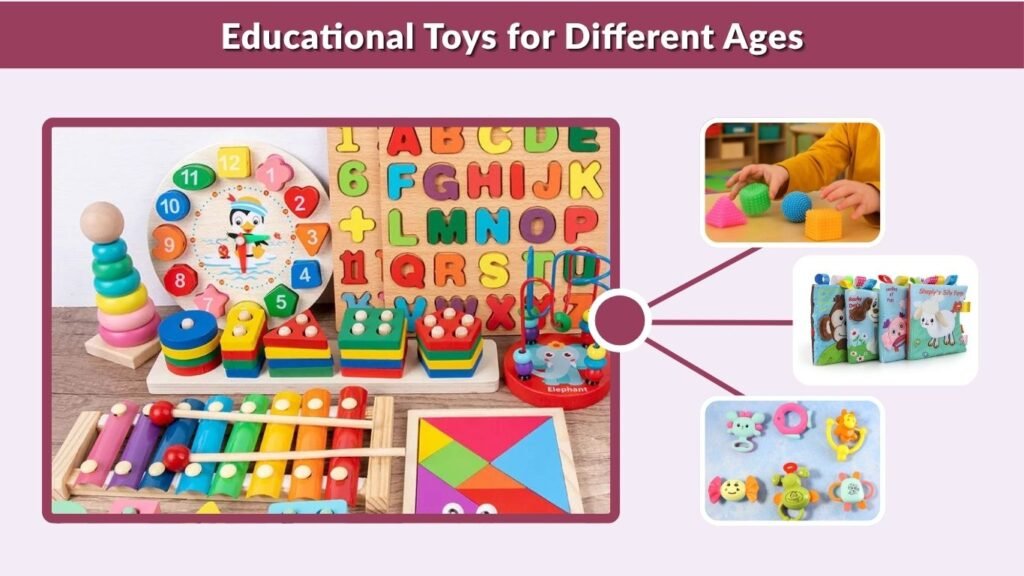
Children’s abilities change quickly, so toys should evolve as they grow. A toy that is ideal for a toddler may provide little challenge to an older child. Age recommendations can provide useful guidance, although individual development and interests should also influence the choice.
Toys for Babies
Suitable educational toys for babies may include:
- Soft sensory toys
- Rattles
- Activity mats
- Teething toys
- Simple stacking toys
- Soft books
These can support sensory exploration, grasping, visual tracking, and early coordination.
Toys for Toddlers
Toddlers may benefit from shape sorters, blocks, large puzzles, pretend-play sets, push toys, and simple musical instruments.
These toys can encourage language, movement, coordination, and problem-solving.
Toys for Preschoolers
Preschool educational toys can become more challenging.
Good options include construction sets, art supplies, science activities, number games, puzzles, pretend-play sets, and simple board games.
Are Educational Toys Better Than Regular Toys?
Educational toys can be valuable, but children do not need every toy to be specifically marketed as educational. Many traditional toys naturally support learning. Blocks encourage construction skills, balls develop coordination, and dolls support imaginative and social play.
Play Quality Matters Most
The way children use a toy is often more important than its label.
A simple cardboard box can become a house, spaceship, car, or shop through imaginative play. This demonstrates how creativity can transform ordinary objects into meaningful learning experiences.
Adult Interaction Adds Value
Parents and caregivers can make almost any toy more educational by asking questions, introducing new vocabulary, or encouraging children to experiment.
The goal is not to control play but to support curiosity while allowing children to make their own discoveries.
Final Thoughts
Understanding what are educational toys makes it easier to recognize that learning can happen through many forms of play. Educational toys may help develop cognitive, physical, language, social, emotional, and creative skills while keeping children actively engaged.
The best learning toys are age-appropriate, safe, interesting, and flexible enough to encourage exploration. They do not have to be expensive or highly technological. Puzzles, blocks, pretend-play materials, books, art supplies, and simple games can all provide meaningful educational experiences when children are encouraged to explore, create, and learn through play.
FAQs
1. What are educational toys?
Educational toys are toys that help children practice skills or learn concepts while playing. They may support problem-solving, language, motor development, creativity, memory, mathematics, science, or social skills. Examples include puzzles, blocks, counting toys, construction sets, pretend-play materials, and educational games.
2. Why are educational toys important?
Educational toys provide children with opportunities to learn through active exploration. They can encourage problem-solving, creativity, communication, coordination, and concentration. Because children are engaged in play, they can repeatedly practice new skills without the experience feeling like a formal lesson.
3. What are examples of educational toys?
Examples include building blocks, puzzles, shape sorters, alphabet toys, counting toys, science kits, musical instruments, construction sets, memory games, art materials, and pretend-play sets. The best choice depends on the child’s age, interests, abilities, and the particular skills you want to encourage.
4. Are electronic educational toys good for children?
Electronic educational toys can support learning when they encourage children to interact, answer questions, or practice specific skills. However, electronic features alone do not make a toy educational. Hands-on toys such as blocks, puzzles, and art materials can provide equally valuable or broader learning opportunities.
5. How do I choose the best educational toy for a child?
Choose a toy that matches the child’s age, interests, abilities, and developmental stage. Look for safe, durable toys that encourage active participation and provide an appropriate challenge. Open-ended toys that can be used in several ways often support creativity and remain useful as children’s skills develop.
