
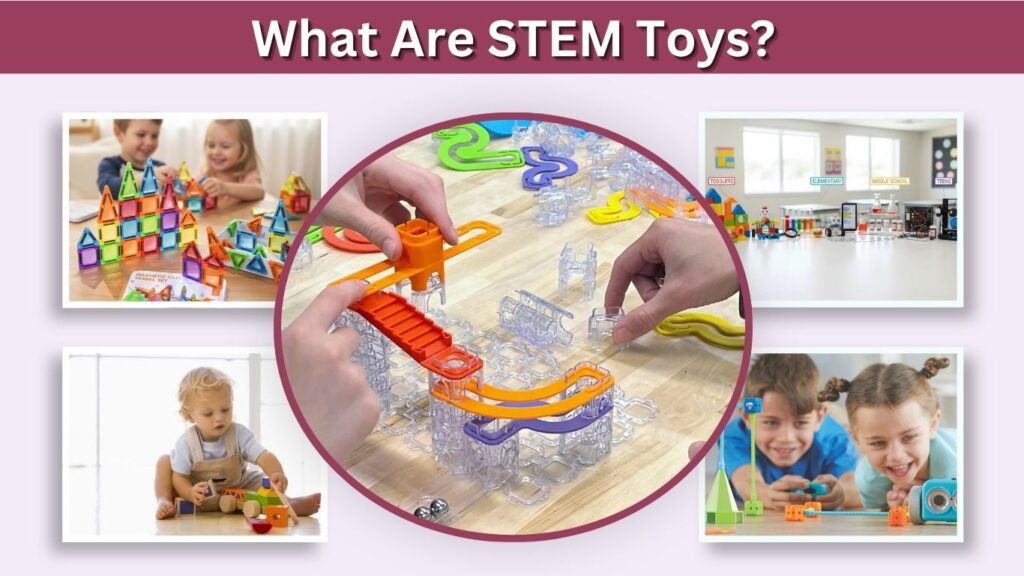
STEM toys are educational toys designed to help children learn science, technology, engineering, and mathematics through hands-on play. These toys encourage kids to build, experiment, solve problems, recognize patterns, and explore how things work. From simple building blocks and puzzles to coding robots and science kits, STEM toys can make learning more enjoyable and practical. They are available for different age groups and can support creativity, logical thinking, curiosity, and problem-solving while allowing children to learn naturally through play.
What Does STEM Mean in Toys?
STEM stands for Science, Technology, Engineering, and Mathematics. In toys, STEM refers to activities that introduce children to one or more of these subjects through practical play. Instead of only reading or memorizing information, children can interact with objects, solve challenges, test ideas, and discover basic concepts by doing activities themselves.
Science
Science-based toys encourage children to observe, experiment, and understand how the natural world works. These toys may involve magnets, plants, chemistry experiments, weather, electricity, animals, or physical forces.
Children can learn basic cause-and-effect relationships by performing simple experiments and watching what happens.
Technology
Technology-focused toys introduce children to coding, electronics, machines, and digital systems.
Coding toys, programmable robots, and beginner electronics kits are common examples. These toys can help children understand how instructions, sequences, and simple computer logic work.
Engineering
Engineering toys focus on building, designing, and improving objects.
Children may construct bridges, vehicles, towers, machines, or other structures. They learn that different materials, shapes, and designs can affect how strong or functional a structure becomes.
Mathematics
Math-related STEM toys help children practice numbers, measurements, shapes, patterns, counting, and logical reasoning.
Young children may learn basic counting and sorting, while older children can explore geometry, fractions, measurement, and problem-solving.
What Are STEM Toys?
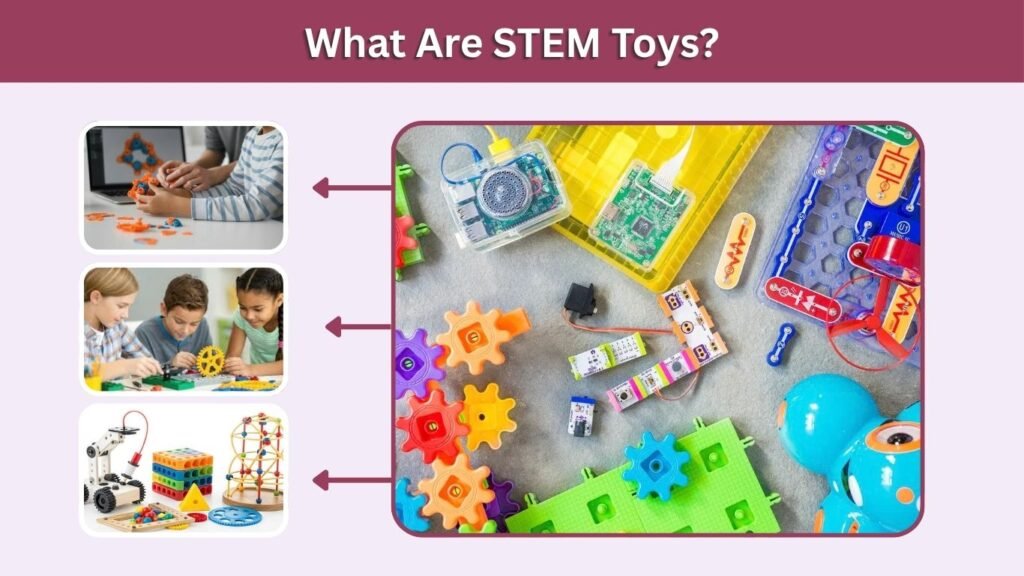
STEM toys are learning toys that encourage children to explore science, technology, engineering, or mathematics while playing. They may be simple physical toys or more advanced electronic products. The main purpose is to make children active participants in learning instead of simply watching or listening. Many STEM toys also combine creativity with practical problem-solving.
Common Characteristics of STEM Toys
Good STEM toys usually encourage exploration rather than providing only one fixed activity.
Common characteristics include:
- Hands-on learning
- Problem-solving activities
- Building and construction
- Experimentation
- Logical thinking
- Creativity and imagination
- Trial-and-error learning
- Age-appropriate challenges
These features allow children to investigate different ideas while developing new skills.
How STEM Toys Work
STEM toys often present children with a challenge or activity.
For example, a child may need to build a bridge that can support several toy cars. If the bridge collapses, the child can change the structure and try again.
Through repeated testing, the child learns about balance, strength, design, and problem-solving without needing a formal classroom lesson.
Benefits of STEM Toys for Children
STEM toys can support several areas of childhood learning and development. Their biggest advantage is that children learn through active participation. Instead of simply being told how something works, they can experiment and discover answers themselves. Age-appropriate STEM activities can also make difficult subjects feel more accessible and enjoyable.
Develop Problem-Solving Skills
Many STEM toys require children to solve a challenge before completing an activity.
A child may need to figure out why a toy vehicle will not move or why a tower keeps falling. Testing different solutions helps children understand that problems can often be solved by changing their approach.
Encourage Critical Thinking
STEM play encourages children to think about why something happens.
They may compare different designs, predict an outcome, observe results, and decide what changes are needed.
These activities help children practice thinking carefully before making decisions.
Support Creativity
STEM toys are not limited to numbers and scientific facts. Many allow children to create their own designs and ideas.
Building sets, magnetic tiles, engineering kits, and robotics toys can encourage children to invent structures, vehicles, machines, or imaginary creations.
Improve Fine Motor Skills
Many STEM activities require children to handle small pieces, connect parts, arrange objects, and build structures.
These activities can help improve:
- Hand-eye coordination
- Finger control
- Grip strength
- Precise movement
- Spatial awareness
Building and construction toys can be particularly useful for practicing these skills.
Examples of STEM Toys
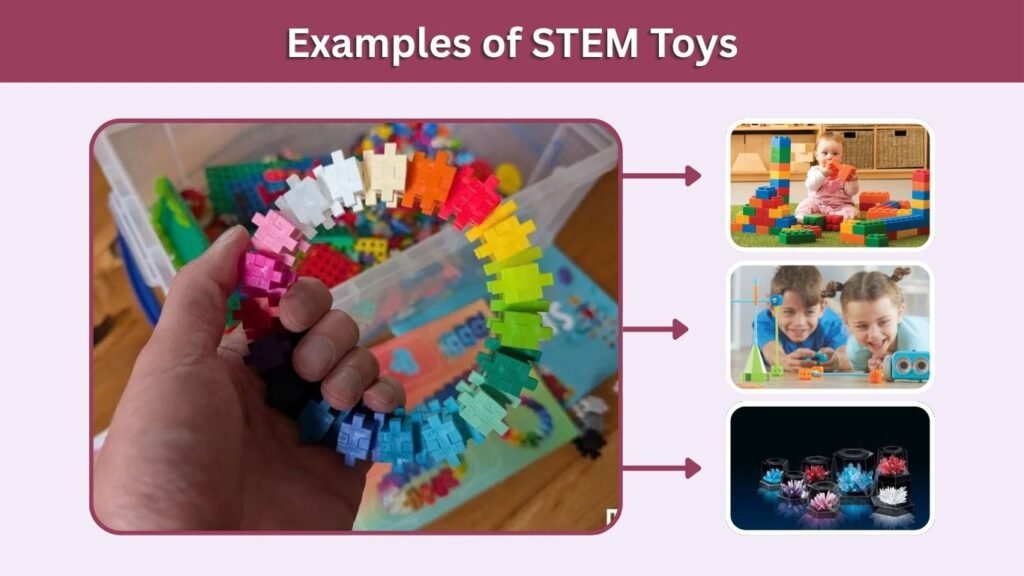
There are many different types of STEM toys available for toddlers, preschoolers, school-age children, and teenagers. Some focus on a single STEM subject, while others combine several areas. The best option usually depends on the child’s age, interests, abilities, and the level of challenge they are ready to handle.
Building Blocks and Construction Sets
Building blocks are one of the simplest examples of STEM toys.
Children can build towers, bridges, houses, vehicles, and other structures. During play, they learn about balance, shapes, stability, size, and spatial relationships.
Construction sets can become more complex as children get older.
Coding and Robotics Toys
Coding toys teach children how instructions and sequences work.
Some toys allow children to program a robot to move through a maze or complete a task. More advanced robotics kits may require children to assemble components before programming their movements.
Science Experiment Kits
Science kits allow children to perform supervised experiments.
Examples may include:
- Crystal-growing kits
- Magnet kits
- Chemistry sets
- Plant-growing kits
- Microscope kits
- Weather experiment kits
- Electricity kits
Parents should always check age recommendations and safety instructions before allowing children to use experiment kits.
Math and Logic Games
Math and logic toys turn numbers and problem-solving into interactive activities.
Examples include number puzzles, counting cubes, pattern games, fraction sets, shape puzzles, and logic challenges.
These toys can make abstract mathematical concepts easier to understand.
STEM Toys for Different Age Groups
STEM toys should match a child’s developmental stage. A toy that is too difficult may cause frustration, while one that is too simple may not provide enough challenge. Manufacturers normally include recommended age ranges, but parents should also consider a child’s individual abilities, interests, and experience with similar activities.
STEM Toys for Toddlers
Toddlers benefit most from simple activities involving colors, shapes, sorting, stacking, and cause and effect.
Suitable options may include large blocks, stacking toys, shape sorters, simple puzzles, and age-appropriate magnetic building pieces.
Small parts should be avoided because they may create choking hazards.
STEM Toys for Preschoolers
Preschoolers can begin exploring more detailed building, counting, patterns, and basic science concepts.
Magnetic tiles, simple coding games, counting toys, beginner science sets, puzzles, and construction kits are popular options.
These toys can introduce basic STEM concepts without making play feel like formal schoolwork.
STEM Toys for School-Age Kids
School-age children can handle more advanced challenges.
Robotics kits, microscopes, engineering sets, circuit kits, coding games, mechanical building toys, and science experiments can provide deeper learning opportunities.
At this stage, children may also enjoy toys that require following instructions and completing multi-step projects.
How to Choose a Good STEM Toy

A good STEM toy should be educational, enjoyable, safe, and suitable for the child’s age. Products labeled as STEM are not automatically useful, so parents should consider how the toy actually encourages learning. Toys that promote active participation, experimentation, creativity, and repeated play usually offer better educational value than toys that only provide passive entertainment.
Check the Recommended Age
Always review the manufacturer’s age recommendation before choosing a toy.
Age guidance can help determine whether the toy’s difficulty level, small parts, materials, and instructions are suitable for the child.
Consider the Child’s Interests
Children are more likely to use a STEM toy when the topic matches something they already enjoy.
A child interested in machines may enjoy engineering kits, while one interested in nature may prefer microscopes or science exploration sets.
Look for Open-Ended Play
Open-ended toys allow children to use the same materials in many different ways.
Good examples include:
- Building blocks
- Magnetic tiles
- Construction sets
- Engineering kits
- Gear sets
- Creative coding toys
These toys can provide repeated play because children can create something different each time.
STEM Toys vs. Regular Educational Toys
STEM toys are a type of educational toy, but not every educational toy is a STEM toy. Educational toys may focus on reading, language, geography, art, music, memory, or social skills. STEM toys specifically focus on science, technology, engineering, and mathematics while encouraging practical exploration and problem-solving.
What Makes STEM Toys Different?
STEM toys usually emphasize experimentation and discovery.
Instead of simply teaching a child to remember an answer, they often encourage children to test ideas and determine why something works.
For example, a traditional number-learning toy may help a child recognize numbers, while a STEM math activity may ask them to use those numbers to solve a practical challenge.
What Are STEAM Toys?

STEAM toys are closely related to STEM toys. The main difference is the addition of the letter “A,” which stands for Arts. STEAM activities combine science and technical learning with creativity, design, visual thinking, music, or artistic expression. These toys are useful for children who enjoy combining imaginative activities with problem-solving.
STEM vs. STEAM
STEM focuses on science, technology, engineering, and mathematics.
STEAM includes those same subjects but also adds art and creativity.
For example, designing and building a model house may involve engineering and mathematics, while decorating and creatively designing the house introduces the artistic element of STEAM.
FAQs
What does STEM toy mean?
A STEM toy is an educational toy that introduces children to science, technology, engineering, or mathematics through hands-on activities, experiments, building, coding, or problem-solving.
What are examples of STEM toys?
Examples include building blocks, magnetic tiles, science kits, coding toys, robotics kits, microscopes, engineering sets, math games, circuit kits, and logic puzzles.
What age should children start using STEM toys?
Children can begin using age-appropriate STEM toys as toddlers. Simple sorting, stacking, and building toys can introduce early STEM concepts, while older children can use more advanced science, engineering, and coding toys.
Are STEM toys good for children’s development?
STEM toys can support problem-solving, logical thinking, creativity, fine motor skills, curiosity, and practical learning when the activities are appropriate for the child’s age and abilities.
What is the difference between STEM and STEAM toys?
STEM toys focus on science, technology, engineering, and mathematics. STEAM toys cover the same subjects but also include art, creativity, and design as an additional part of the learning experience.
