

Cause and effect toys are educational playthings that help children understand how their actions produce specific results. When a baby presses a button and hears music or a toddler pushes a ball down a ramp, they begin learning about cause and effect. These toys encourage curiosity, problem-solving, coordination, and early cognitive development through hands-on experiences. Available in various shapes, sizes, and difficulty levels, cause and effect toys support babies, toddlers, and preschoolers as they explore their surroundings and develop essential learning skills through everyday play activities.
What Are Cause and Effect Toys?
Cause and effect toys are interactive toys designed to demonstrate the relationship between an action and its outcome. For example, pressing a button may activate a light, pulling a string may move an object, or dropping a ball may create a sound. These simple experiences help children recognize patterns, predict results, and understand how their actions influence the environment around them.
How Cause and Effect Toys Work
Cause and effect toys respond to specific actions performed by children. These actions may include pushing, pulling, shaking, stacking, dropping, or turning objects. Each movement produces a noticeable result that encourages children to repeat the activity and investigate how the toy functions.
Why Cause and Effect Learning Matters
Understanding cause and effect is an important foundation for early childhood development. It helps children connect actions with outcomes, develop logical thinking, and recognize predictable patterns. These abilities eventually support problem-solving, communication, and everyday decision-making.
10 Best Examples of Cause and Effect Toys
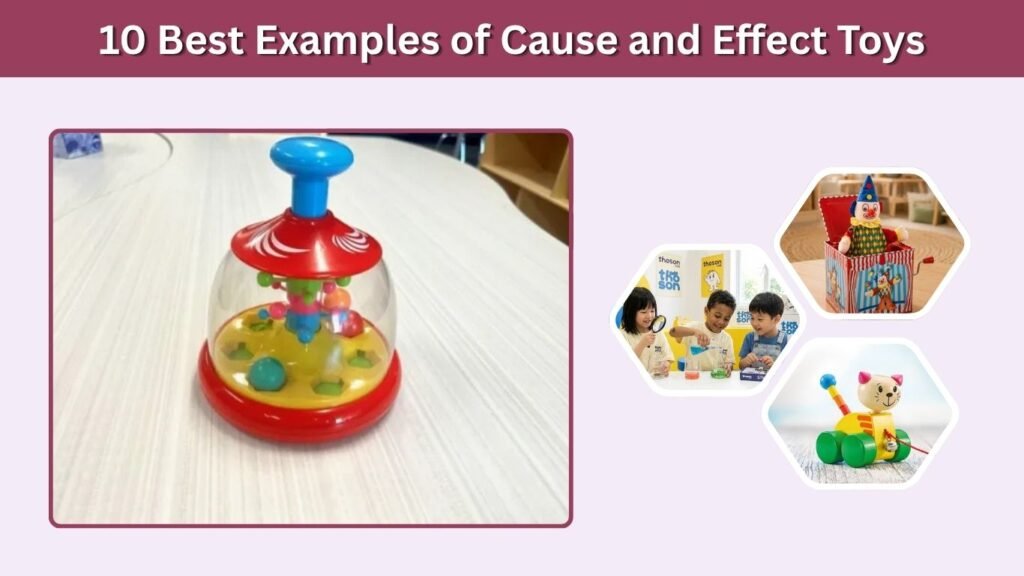
Cause and effect toys come in many forms, from simple rattles to interactive learning centers. The best examples provide clear responses when children perform specific actions. Some toys develop fine motor skills, while others encourage movement, sensory exploration, or logical thinking. Choosing developmentally appropriate toys allows children to explore relationships between actions and outcomes in enjoyable ways.
1. Pop-Up Toys
Pop-up toys feature buttons, switches, or levers that release hidden characters or objects. Children learn that pressing or moving a particular control produces a predictable response. These toys also improve finger coordination and hand-eye coordination.
2. Ball Drop Toys
Ball drop toys allow children to place balls into holes, ramps, or tracks. Watching the balls roll, bounce, or disappear teaches movement, direction, and consequences. They also encourage visual tracking and problem-solving.
3. Musical Button Toys
Musical toys produce sounds, melodies, or rhythms when children press buttons. They demonstrate how physical actions create auditory responses while supporting listening skills and sensory exploration.
4. Jack-in-the-Box Toys
A jack-in-the-box releases a character when children turn a handle or activate a mechanism. This classic toy introduces anticipation, sequence, and predictable outcomes. Some young children may prefer gentler versions without sudden surprises.
5. Light-Up Activity Toys
Light-up toys respond to actions with colorful lights or visual patterns. Children discover that pushing, shaking, or touching certain parts creates changes. These toys can encourage attention and repeated experimentation.
6. Shape Sorters
Shape sorters require children to match objects with corresponding openings. When the correct shape enters its hole, children experience a successful outcome. This activity supports spatial awareness and problem-solving.
7. Stacking and Nesting Toys
Stacking cups, rings, and blocks demonstrate what happens when objects are balanced, placed together, or knocked down. Children develop an understanding of stability, size, and physical relationships.
8. Pull-Along Toys
Pull-along toys move when children pull an attached string or handle. Some feature spinning wheels, moving parts, or gentle sounds. These toys encourage walking practice and an understanding of movement.
9. Toy Car Ramps
Toy car ramps allow children to release vehicles and observe how they travel downhill. Changing the starting position or ramp angle provides opportunities to experiment with speed, distance, and movement.
10. Busy Boards
Busy boards include switches, latches, buttons, wheels, and other interactive components. Each mechanism creates a different response, allowing children to investigate actions while developing fine motor control.
Benefits of Cause and Effect Toys for Child Development
Cause and effect toys offer more than entertainment because they provide meaningful opportunities for children to learn through experimentation. By repeatedly interacting with objects, children discover patterns and develop confidence in their abilities. These activities support several developmental areas, including cognitive growth, motor coordination, attention, and communication. The benefits depend on the child’s age, interests, and level of participation.
Cognitive Development
Cause and effect activities encourage children to think about relationships between actions and results. Repeating an action helps them remember what happened previously and predict what might happen next. This supports early reasoning and memory development.
Fine Motor Skills
Pressing buttons, turning knobs, and manipulating small objects strengthen hand and finger coordination. These movements help children practice precise actions that are useful for drawing, feeding, dressing, and other daily activities.
Problem-Solving Skills
When a toy does not respond as expected, children may try different movements or approaches. This experimentation encourages flexible thinking and persistence. Discovering a solution can also increase confidence and independent exploration.
Language and Communication
Caregivers can describe actions and results while children play. Phrases such as “You pushed the button, and the music started” help connect words with experiences. Shared play also encourages attention, interaction, and early communication.
Cause and Effect Toys by Age Group

Children develop cause and effect understanding gradually, so toys should match their changing abilities and interests. Younger babies benefit from simple sensory responses, while toddlers often enjoy toys that require movement and experimentation. Preschoolers may prefer more complex activities involving sequences and predictions. Age recommendations, developmental readiness, and safety considerations should guide toy selection.
Cause and Effect Toys for Babies (0–12 Months)
Babies benefit from simple toys that respond to shaking, touching, or gentle movement. Soft rattles, textured balls, and basic activity toys encourage sensory exploration. As babies grow, they become increasingly interested in repeating actions that produce familiar results.
Cause and Effect Toys for Toddlers (1–3 Years)
Toddlers enjoy toys involving buttons, levers, stacking, and movement. Pop-up toys, ball ramps, shape sorters, and busy boards provide opportunities to experiment independently. These activities strengthen coordination and introduce more challenging problem-solving experiences.
Cause and Effect Toys for Preschoolers (3–5 Years)
Preschoolers can explore toys involving multiple actions and outcomes. Marble runs designed for their age, building sets, simple mechanical toys, and interactive puzzles encourage planning and prediction. These experiences help children understand more complex relationships.
How to Choose the Best Cause and Effect Toys
Choosing appropriate cause and effect toys involves considering a child’s developmental abilities, safety, and interests. Effective toys should provide understandable responses while allowing children to explore independently. Simple designs are often especially useful because they make the connection between actions and outcomes easy to recognize. Parents should prioritize engaging, durable toys that encourage active participation.
Important Features to Consider
- Age appropriateness: Choose toys that match the child’s developmental stage.
- Safety: Avoid choking hazards, accessible button batteries, sharp edges, and loose components.
- Clear responses: Select toys that produce noticeable results after an action.
- Durability: Look for sturdy materials suitable for repeated handling.
- Interactive design: Prioritize toys that encourage active exploration rather than passive watching.
Fun Cause and Effect Activities Without Toys

Children do not always need specialized toys to understand cause and effect. Many everyday activities naturally demonstrate how actions influence objects and surroundings. Simple experiences involving water, movement, sound, and household materials can encourage experimentation. These activities also provide opportunities for parents and caregivers to interact with children while explaining what happens during play.
1. Rolling Balls
Roll a large ball across the floor and encourage your child to push it back. Changing the force or direction helps demonstrate how different movements influence the ball’s motion.
2. Building and Knocking Down Blocks
Help children build towers using large, lightweight blocks. Allowing them to knock the towers down demonstrates how physical actions affect balance and stability.
3. Water Pouring Activities
Provide containers of different sizes and let children transfer small amounts of water between them. This activity demonstrates filling, emptying, and movement while strengthening coordination. Always supervise water play closely.
4. Making Sounds With Objects
Use safe household objects to create sounds through tapping, shaking, or gentle striking. Children can compare how different actions and materials produce different sounds.
How Parents Can Encourage Cause and Effect Learning
Parents and caregivers play an important role in helping children understand cause and effect relationships. Providing opportunities for exploration, allowing repetition, and responding positively to discoveries can make learning more meaningful. Children often develop a stronger understanding when adults participate without controlling every activity. Everyday interactions can become valuable learning experiences through simple conversations and shared attention.
Encourage Repetition
Allow children to repeat actions several times without unnecessary interruption. Repetition helps them recognize patterns, remember outcomes, and develop confidence in predicting what will happen.
Describe Actions and Results
Use simple language to explain what happens during play. Statements such as “The ball rolled because you pushed it” help children connect physical experiences with meaningful words and concepts.
Let Children Explore Independently
Give children opportunities to experiment with toys at their own pace while providing appropriate supervision. Avoid immediately demonstrating every solution, allowing them to discover different outcomes through trial and error.
FAQs
1. What is an example of a cause and effect toy?
A pop-up toy is a common example of a cause and effect toy. When a child presses a button or moves a lever, a character appears. This predictable response helps children understand how one action produces a specific result.
2. At what age do babies understand cause and effect?
Babies begin exploring simple cause and effect relationships during their first year. As they develop, they intentionally repeat actions such as shaking rattles or dropping objects. Their understanding becomes more advanced throughout toddlerhood and early childhood.
3. Are cause and effect toys good for toddlers?
Yes, cause and effect toys are beneficial for toddlers because they encourage experimentation, coordination, and early problem-solving. Interactive toys with buttons, ramps, and moving parts help toddlers recognize relationships between their actions and the results they observe.
4. Do cause and effect toys help children with autism?
Cause and effect toys can provide enjoyable learning opportunities for autistic children, depending on their individual preferences and sensory needs. Toys with clear, predictable responses may support engagement, exploration, and skill practice without requiring complicated instructions.
5. Can homemade toys teach cause and effect?
Yes, homemade activities using safe household materials can demonstrate cause and effect effectively. Rolling balls, stacking containers, and creating gentle sounds allow children to observe predictable outcomes. Adult supervision and age-appropriate materials are essential for safe exploration.
