

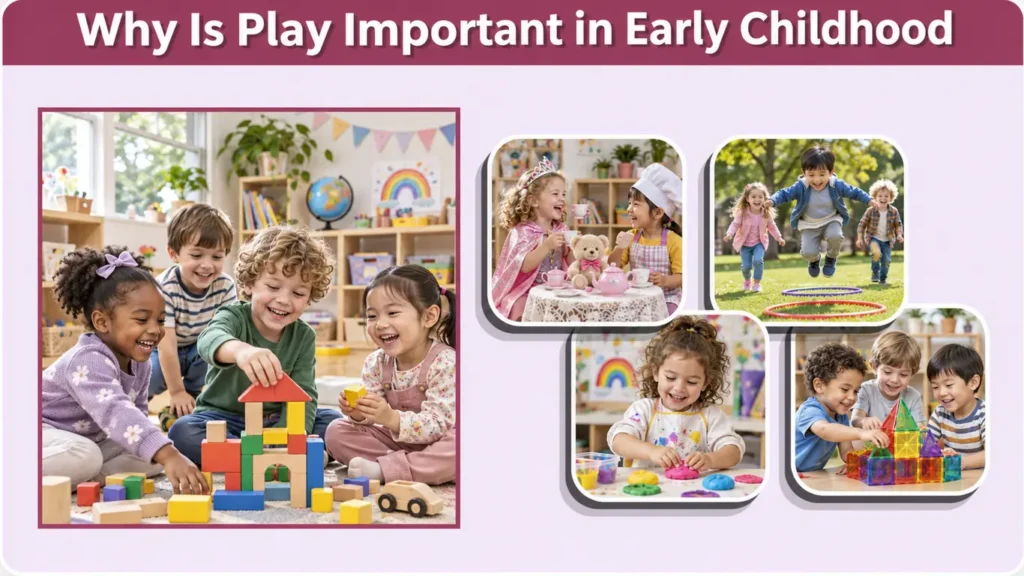
Play is an essential part of early childhood that supports children’s physical, cognitive, social, and emotional development. Through playful activities, children explore their surroundings, develop new skills, express emotions, and build meaningful relationships with others. Understanding why play is important in early childhood helps parents, caregivers, and educators create better learning opportunities for young children. Whether through building blocks, outdoor games, imaginative activities, or group play, children gain valuable experiences that strengthen their creativity, confidence, independence, and problem-solving abilities while building a strong foundation for future learning.
What Is Play in Early Childhood?
Play in early childhood refers to enjoyable activities that allow children to explore, experiment, imagine, and interact with their environment. These activities can be spontaneous, child-directed, or supported by adults.
Unlike formal learning, play encourages children to discover new concepts through direct experiences. It allows them to develop essential life skills at their own pace while making learning enjoyable and meaningful.
Characteristics of Play in Early Childhood
Play has several important characteristics that contribute to healthy childhood development. These characteristics help distinguish meaningful play from strictly instructional activities.
- Enjoyable: Children participate because they find the activity interesting and entertaining.
- Active: Play involves physical, mental, or social engagement.
- Creative: Children use imagination to explore different possibilities.
- Flexible: Activities can change according to children’s interests.
- Exploratory: Children investigate new objects, ideas, and environments.
- Voluntary: Children often choose how and when they participate.
Why Is Play Important in Early Childhood? 10 Key Benefits

Play contributes to nearly every area of childhood development by providing opportunities for exploration, communication, movement, and independent thinking. Children naturally learn through hands-on activities that encourage curiosity and participation.
Regular play experiences also help children understand their surroundings and develop practical skills. The following ten benefits explain the importance of play during the early years of life.
1. Supports Cognitive Development
Play stimulates brain development by encouraging children to think, remember, concentrate, and make decisions. Activities such as puzzles, sorting objects, and building blocks help children understand patterns, shapes, numbers, and relationships.
2. Improves Physical Development
Active play strengthens muscles, improves coordination, and supports healthy physical growth. Running, jumping, climbing, and throwing help children develop gross motor skills, while drawing and manipulating small objects improve fine motor skills.
3. Develops Social Skills
Playing with others teaches children how to communicate, cooperate, share, and take turns. Group activities also provide opportunities to understand different perspectives, resolve disagreements, and develop positive friendships.
4. Encourages Emotional Development
Play provides a natural way for children to express their feelings and understand emotions. Through pretend scenarios and everyday interactions, children gradually learn to manage frustration, recognize feelings, and develop emotional regulation skills.
5. Enhances Language and Communication
Children develop communication skills while discussing ideas, asking questions, and participating in imaginative activities. Storytelling, role-playing, and group games introduce new vocabulary and encourage children to express their thoughts clearly.
6. Promotes Creativity and Imagination
Creative play encourages children to explore original ideas without relying on fixed instructions. Drawing, pretend cooking, storytelling, and building imaginary worlds help children develop flexible thinking and creative expression.
7. Strengthens Problem-Solving Skills
Play introduces challenges that require children to experiment with different solutions. Completing puzzles, constructing towers, or creating game rules teaches children to evaluate possibilities, learn from mistakes, and overcome difficulties.
8. Builds Confidence and Independence
When children successfully complete playful tasks, they develop a sense of achievement. Making independent choices during play also helps them become more comfortable exploring unfamiliar activities and trusting their abilities.
9. Supports School Readiness
Play develops foundational skills that prepare children for formal education. Listening, following directions, communicating, recognizing patterns, and cooperating with others can make the transition into school easier.
10. Reduces Stress and Supports Well-Being
Enjoyable play activities provide opportunities for relaxation, emotional expression, and positive experiences. Regular play can help children cope with everyday stress while supporting their overall happiness and emotional well-being.
Types of Play That Support Early Childhood Development
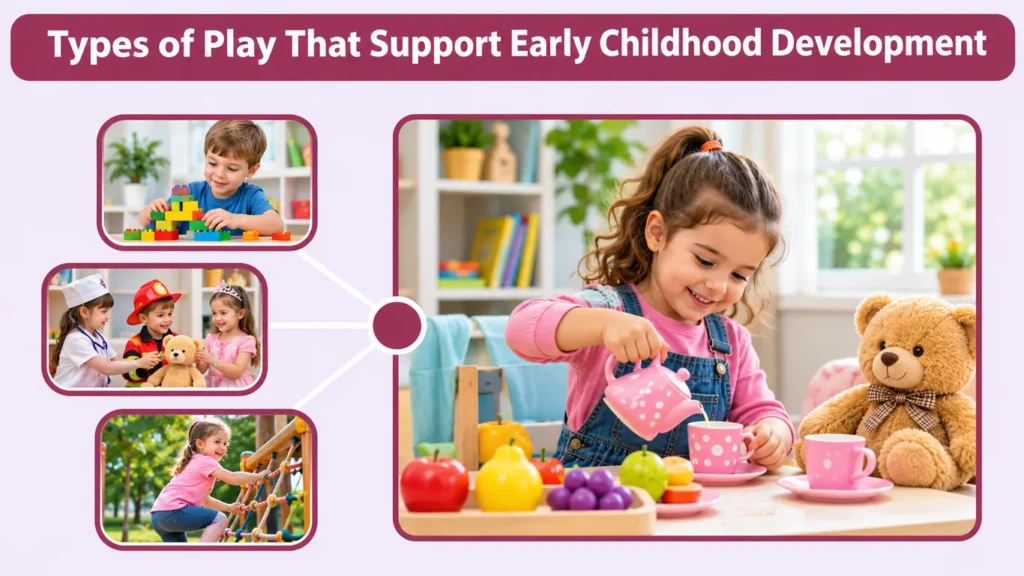
Different types of play contribute to different aspects of children’s growth. Some activities encourage physical movement, while others focus on creativity, communication, sensory exploration, or problem-solving.
Providing a variety of playful experiences allows children to discover their interests and develop a balanced range of abilities. Parents and educators can introduce the following types of play throughout daily routines.
Common Types of Play
- Physical Play: Running, jumping, dancing, and climbing strengthen physical abilities.
- Constructive Play: Building blocks and other materials develop planning and problem-solving skills.
- Pretend Play: Imaginary situations encourage creativity, language, and emotional expression.
- Sensory Play: Exploring textures, sounds, water, and sand supports sensory learning.
- Exploratory Play: Investigating unfamiliar objects encourages curiosity and discovery.
- Associative Play: Children interact and share materials without necessarily pursuing a common goal.
- Cooperative Play: Working together toward shared goals develops teamwork and communication.
- Creative Play: Painting, drawing, music, and crafts encourage self-expression.
How Play Supports Learning in Early Childhood
Play makes learning interactive by allowing children to engage directly with new ideas and experiences. Instead of depending entirely on instructions, children develop understanding through experimentation, observation, repetition, and discovery.
Play-based learning connects educational concepts with enjoyable activities that children can understand. This approach encourages curiosity, strengthens engagement, and helps children develop positive attitudes toward learning from an early age.
Learning Through Exploration
Exploratory activities allow children to investigate how objects and materials behave. For example, playing with water introduces concepts such as movement, volume, floating, and sinking through practical experiences.
Developing Early Mathematics Skills
Counting toys, sorting shapes, and comparing sizes introduce basic mathematical concepts naturally. Building activities also help children develop spatial awareness, recognize patterns, and understand simple measurements.
Strengthening Early Literacy Skills
Storytelling, picture books, pretend play, and singing support early literacy development. These activities encourage listening comprehension, vocabulary development, sound recognition, and interest in written language.
How Parents and Educators Can Encourage Meaningful Play
Parents and educators play an important role in creating environments that encourage healthy childhood development. Children benefit from having sufficient time, appropriate materials, safe spaces, and supportive relationships during playful activities.
Adults do not need to control every aspect of play. Instead, they can provide guidance when necessary while allowing children to make choices, explore independently, and develop their natural interests.
Effective Ways to Encourage Play
- Provide open-ended toys: Offer blocks, art materials, and age-appropriate objects that encourage creativity.
- Encourage outdoor activities: Create opportunities for running, climbing, and exploring nature.
- Allow unstructured play: Give children time to choose their own activities without constant adult direction.
- Create safe play spaces: Provide accessible areas with suitable materials and age-appropriate supervision.
- Participate in play: Join children’s activities while respecting their ideas and decisions.
- Encourage social interaction: Arrange opportunities for children to play with their peers.
- Ask open-ended questions: Encourage children to explain their ideas and discover new possibilities.
- Balance screen time: Ensure digital entertainment does not replace active, social, or imaginative play.
What Happens When Children Do Not Get Enough Play?
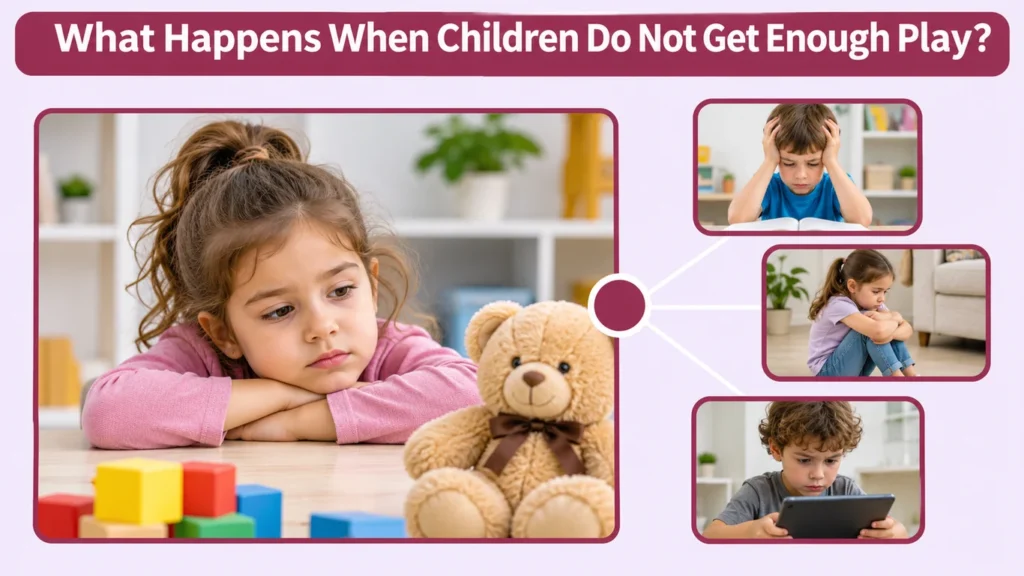
Limited opportunities for play may affect several areas of childhood development. Children who regularly experience restricted play may have fewer opportunities to practice communication, physical coordination, emotional regulation, and independent thinking.
Although developmental outcomes depend on many factors, providing regular and meaningful play experiences helps children access important learning opportunities. A balanced daily routine should include rest, learning, movement, and enjoyable activities.
Reduced Social and Emotional Opportunities
Children with limited social play opportunities may have fewer chances to practice cooperation, sharing, and conflict resolution. They may also miss valuable experiences that help them understand and express emotions.
Limited Physical and Creative Development
Insufficient active play can reduce opportunities to strengthen muscles and improve coordination. Similarly, limited imaginative play may restrict opportunities for creative expression, independent decision-making, and flexible thinking.
FAQs
1. Why is play important for brain development in early childhood?
Play supports brain development by encouraging children to explore, think, communicate, and solve problems. Repeated playful experiences help strengthen learning processes associated with memory, attention, reasoning, language development, and emotional regulation during the early years.
2. How does play help children learn?
Play helps children learn through direct experiences, experimentation, and active participation. Activities such as building blocks, storytelling, and sorting objects introduce educational concepts naturally while encouraging curiosity, creativity, and independent thinking.
3. How much play do young children need?
Young children should have regular opportunities for play throughout the day. The appropriate amount depends on their age, developmental needs, and daily routines, but activities should include a healthy balance of physical, imaginative, social, and independent play.
4. What is the most important type of play in early childhood?
No single type of play is best for every aspect of development. Physical, sensory, imaginative, constructive, and social play each provide different benefits, making a combination of activities ideal for supporting children’s overall growth and learning.
5. Why is unstructured play important in early childhood?
Unstructured play allows children to choose their activities, create rules, and explore ideas independently. It encourages creativity, confidence, decision-making, and problem-solving while giving children opportunities to discover their interests without excessive adult direction.
